
IPTV vs Cable TV: Which Is Better in 2026?
Choosing between IPTV vs Cable TV can be confusing because both technologies allow viewers to watch television, movies, sports, news and entertainment, but they deliver content in very different ways.
Traditional cable television has been used for decades and normally delivers television programming through a dedicated cable network. IPTV, on the other hand, delivers television and video content using internet protocol technology.
This technology is known as IPTV, or Internet Protocol Television.
In this guide, you will learn what IPTV is, how it works, which devices can be used, what internet speed is recommended, and what you need to start streaming.
So, what are the real differences between IPTV and cable TV, and which option makes more sense in 2026?
This guide compares IPTV vs Cable TV in terms of technology, devices, flexibility, internet requirements, picture quality and everyday use.
If you are new to internet television, start with our What Is IPTV? Complete Guide to understand how IPTV technology works before comparing the two options.
IPTV vs Cable TV: What Is the Main Difference?
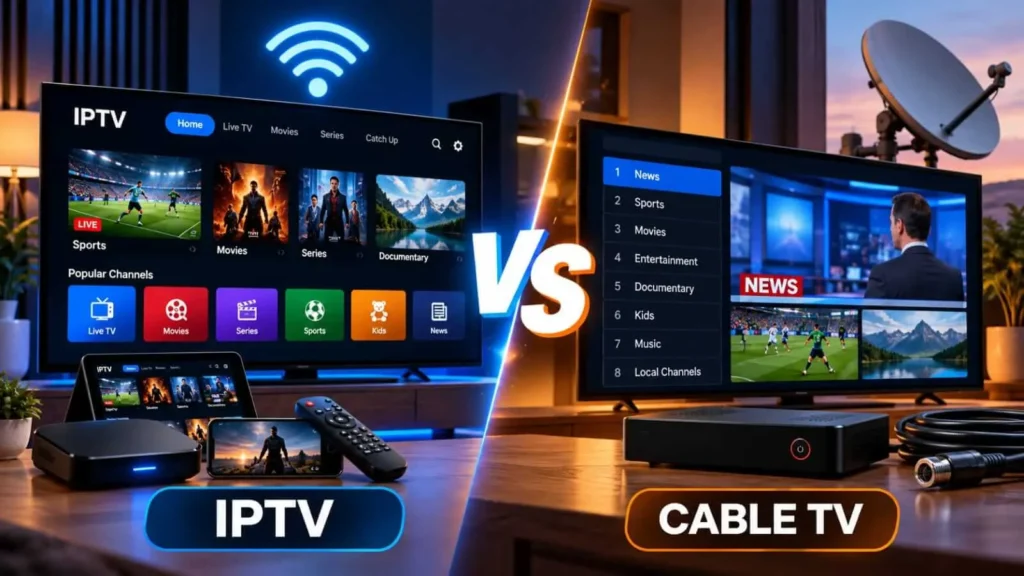
The biggest difference between IPTV vs Cable TV is how television content reaches your screen.
Cable television traditionally delivers programming through a cable system connected to the subscriber’s home. Cable services may include different service tiers and equipment depending on the operator and package. U.S. communications regulations, for example, distinguish between basic cable service and additional cable programming services.
IPTV uses internet protocol networks to deliver video content.
Instead of receiving television programming through a traditional cable television connection, IPTV sends video data through an internet connection to a compatible device or application.
In simple terms:
Cable TV → television content through a cable television network
IPTV → television content through an IP/internet-based network
That difference affects almost everything else, including device compatibility, installation and viewing flexibility.
How Does IPTV Work?
IPTV delivers video data over an IP network.
When viewers select content, video information is transmitted from remote servers to the viewing device.
This is closely related to the way modern internet video streaming works. Cloudflare explains that streaming continuously sends portions of video or audio from a remote server to the user’s device rather than requiring the entire media file to be downloaded first.
Depending on the service, IPTV can provide access to live television, video-on-demand and other forms of streamed programming.
Compatible devices can include Smart TVs, Android TV devices, smartphones, tablets, computers and dedicated streaming devices.
How Does Cable TV Work?
Cable television normally uses infrastructure operated by a cable provider to deliver television programming to subscribers.
A television or set-top box receives the programming available through the subscriber’s package.
Modern cable networks are much more advanced than early analog cable systems and may combine digital television, internet access and other telecommunications services.
Cable packages can also involve equipment or installation charges depending on the provider and region. U.S. cable regulations, for example, treat equipment and installation charges separately from certain regulated programming charges.
IPTV vs Cable TV: Device Compatibility
Device flexibility is one of the biggest differences when comparing IPTV vs Cable TV.
Traditional cable services are generally centered around televisions connected through the provider’s equipment or approved devices.
IPTV can potentially operate across a broader range of internet-connected devices.
A compatible IPTV service may work on:
Smart TVs, streaming boxes, Amazon Fire TV devices, Android TV devices, smartphones, tablets and computers.
This can make IPTV useful for households where viewers want access to television from several types of screens.
However, actual device compatibility always depends on the application and service being used.
For device-specific instructions, visit our IPTV Installation Guide.
IPTV vs Cable TV: Internet Requirements
Another major difference in the IPTV vs Cable TV comparison is internet dependency.
IPTV requires a reliable network connection because the video is delivered through an IP network.
If the internet connection becomes unstable, viewers may experience reduced video quality, buffering or interruptions.
Cable television programming does not necessarily depend on the viewer’s home internet connection in the same way.
This means that internet quality becomes especially important when using IPTV.
For context, Netflix currently recommends stable connections of at least 5 Mbps for Full HD 1080p and 15 Mbps for Ultra HD 4K streaming. Those figures are Netflix-specific rather than universal IPTV requirements, but they provide a useful reference for understanding how resolution affects bandwidth requirements.
Actual IPTV bandwidth requirements vary according to stream bitrate, resolution, device and network conditions.
IPTV vs Cable TV: Picture Quality
Both IPTV and cable television can provide high-quality video.
Picture quality is not determined simply by choosing IPTV or cable.
Several factors affect what viewers actually see on screen.
With IPTV, quality can depend on the original stream, compression, server infrastructure, internet stability and the viewing device.
Many internet streaming systems can adapt quality according to available bandwidth. Netflix, for example, explains that its streaming quality may automatically change when internet connections become slower or unstable.
Cable quality can similarly depend on the provider, package, signal and equipment.
Therefore, claims that one technology always offers better picture quality than the other are too simplistic.
IPTV vs Cable TV: Flexibility
Flexibility is an important reason viewers compare IPTV vs Cable TV.
Internet-based television services can allow users to watch supported content across several compatible devices.
A viewer might use a Smart TV at home, a tablet in another room or a smartphone when appropriate.
Cable television has traditionally been more closely associated with fixed television installations and provider equipment, although many modern cable companies now also provide apps and internet-based viewing options.
The distinction between traditional television and streaming has therefore become less absolute over time.
Still, IPTV is fundamentally designed around IP-based delivery.
Live TV and Video on Demand
Both IPTV and modern cable services may offer live television and video-on-demand.
Video-on-demand allows viewers to select programming when they want to watch it rather than following only a fixed broadcast schedule.
This feature is not exclusive to IPTV. Cable providers have also offered video-on-demand systems for many years.
The important difference is the underlying delivery technology rather than simply whether on-demand content exists.
IPTV vs Cable TV: Installation
Installation can be another important consideration.
Traditional cable may require a physical cable connection, provider equipment or professional installation depending on the service.
IPTV normally focuses more heavily on internet connectivity and compatible software or hardware.
A typical IPTV setup involves a compatible device, internet connection, IPTV player and properly configured service.
The exact process varies between Smart TVs, Android devices, Fire TV products and other platforms.
You can follow our IPTV Installation Guide for device-specific instructions.
IPTV vs Cable TV: Buffering and Reliability
Buffering is commonly associated with internet streaming.
It happens when the player does not receive enough video data quickly enough to maintain continuous playback.
Possible causes include weak Wi-Fi, network congestion, limited bandwidth or temporary problems elsewhere in the streaming path.
Cloudflare notes that streaming performance depends on factors such as network conditions and the distance between viewers and the servers delivering content.
Cable television can experience other types of service problems, including provider outages or signal problems, but it is usually less directly affected by a household’s Wi-Fi performance.
Therefore, when comparing IPTV vs Cable TV, the quality of your internet connection is particularly important for IPTV.
Ethernet vs Wi-Fi for IPTV
A wired Ethernet connection can sometimes provide more consistent performance than Wi-Fi for stationary devices such as Smart TVs and streaming boxes.
Wi-Fi remains convenient, but performance can vary because of distance, walls, interference and the number of devices using the wireless network.
For a television located near the router, Ethernet can therefore be worth considering when maximum network stability is important.
IPTV vs Cable TV: Which Offers More Device Freedom?
IPTV generally has an advantage when the service supports multiple device platforms.
Instead of being tied exclusively to one television installation, users can potentially access compatible services from multiple internet-connected devices.
Cable companies increasingly offer mobile and streaming applications too, so consumers should compare the actual capabilities of individual providers rather than assuming every IPTV or cable service behaves in exactly the same way.
What About 4K Streaming?
4K video contains significantly more visual information than lower-resolution formats and therefore typically requires more bandwidth.
A 4K-compatible television alone does not guarantee 4K streaming.
The content itself must be available in 4K, the player and device must support it, and the network must provide enough stable bandwidth.
For comparison, Netflix recommends at least 15 Mbps for its Ultra HD streaming.
For IPTV, requirements depend on the bitrate and encoding used by the specific stream.
Is IPTV Legal?
IPTV is a technology, and the technology itself is not inherently illegal.
What matters is whether a particular service has the necessary rights or authorization to distribute the content it provides.
Users should choose services that operate lawfully and provide properly licensed programming.
This distinction is important because the term IPTV describes the method used to deliver content rather than automatically determining whether a provider is authorized to distribute that content.
IPTV vs Cable TV: Which Is Better?
There is no universal winner in the IPTV vs Cable TV comparison.
IPTV may be attractive to users who value internet-based delivery, compatibility with several devices and flexible viewing options.
Cable television may appeal to users who prefer a traditional television service or who do not want television viewing to depend heavily on their home internet connection.
The better option depends on your location, provider availability, internet quality, devices, preferred programming and budget.
Instead of selecting a service purely because it is labelled IPTV or cable, compare the actual features, reliability, customer support and content offered by the provider.
IPTV vs Cable TV Comparison
| Feature | IPTV | Cable TV |
|---|---|---|
| Delivery | IP/internet network | Cable provider network |
| Internet required | Generally yes | Not always for traditional TV service |
| Smart TV support | Often | Depends on provider |
| Mobile device support | Often | Depends on provider/app |
| 4K capability | Possible | Possible |
| Network sensitivity | Internet quality matters | Less dependent on home Wi-Fi |
| Installation | Often app/device based | May require provider equipment |
| On-demand content | Often available | Often available |
| Live television | Available depending on service | Available |
| Portability | Usually more flexible | Provider-dependent |
Frequently Asked Questions About IPTV vs Cable TV
Is IPTV better than cable TV?
Neither option is automatically better. IPTV may provide more flexibility across internet-connected devices, while cable can provide a more traditional television setup. The best choice depends on the provider, connection and viewing needs.
Does IPTV need internet?
Yes, IPTV relies on an IP network to deliver video content, so network stability is an important part of the viewing experience.
Can IPTV provide 4K quality?
Yes, IPTV can support 4K when the content, service, device and internet connection all support the required resolution and bitrate.
Does cable TV require internet?
Traditional cable television service does not necessarily require the user’s home internet connection for basic TV viewing. However, additional apps, interactive services and streaming features may require internet access.
Can IPTV work on a Smart TV?
Many Smart TVs support compatible IPTV applications. Compatibility depends on the television operating system and IPTV player.
Is IPTV the same as streaming?
IPTV uses IP networks to deliver television programming, while streaming is a broader term covering many forms of internet-delivered video and audio.
Final Thoughts
The IPTV vs Cable TV debate is really a comparison between two different approaches to delivering television.
Cable TV remains a familiar option built around provider infrastructure and traditional television packages.
IPTV uses internet protocol technology and can offer greater flexibility across compatible connected devices.
For viewers with reliable internet and modern streaming hardware, IPTV can provide a flexible television experience. For others, traditional cable may continue to provide the simplicity or service structure they prefer.
Before choosing either option, compare the actual provider, supported devices, content availability, network requirements and customer support.
To learn more, read our What Is IPTV? How IPTV Works Guide, explore our IPTV subscription plans or IPTV Installation Guide, or visit our FAQ for additional streaming information.
________________________________________________________________________________________________________________
Sources, retrieved October 2026:
Cloudflare, What Is Streaming? How Video Streaming Works
Cloudflare Streaming Guide
Netflix Help Center, Netflix-Recommended Internet Speeds
Netflix Internet Speed Recommendations
Netflix Help Center, How to Get the Best Video Quality
Netflix Video Quality Guide
Electronic Code of Federal Regulations / Cornell Law, Cable Programming Service Definitions
47 CFR §76.901 Cable Definitions